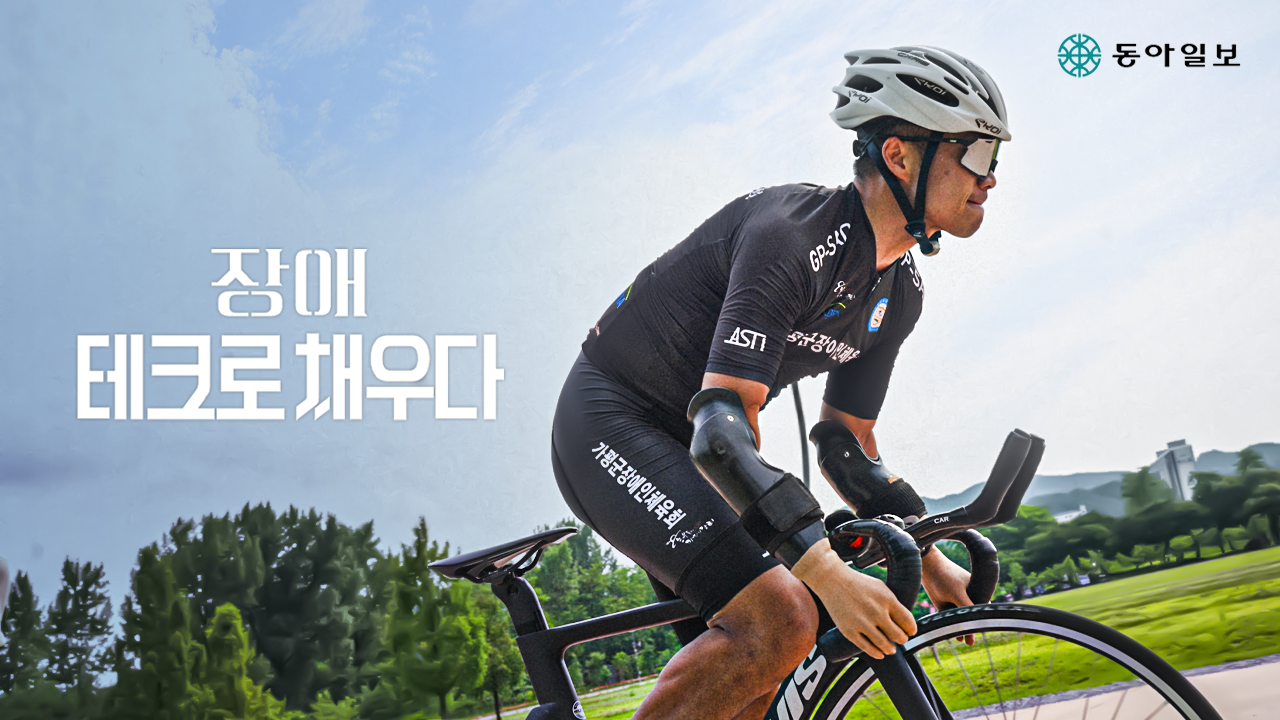
The Dong-A Ilbo special project [Filling Disability with Tech] series concluded on July 29th. The epilogue of this series features the 'My Life, My Daily Routine' as told by the protagonists of each episode. Listen to their vivid voices sharing how life can begin anew. Also, meet the story of Go Mi-sook, a 'marketer who sees the world through her fingertips,' whose story couldn't be fully told due to space constraints.

For beautiful lives in diverse bodies

Kim Ye-sol (Furniture Designer active in Sweden, Founder of Lilla Elephant)
The power of 'This is what I think' is immense, sometimes changing a person's life and the world around them.
Growing up with a disability, my desires to eat, sleep, and play were similar to my friends, but the world seemed to treat me differently. I wish people could just see the difference as it is, but it felt like they were constantly deducting points from my life's report card as if being different was a flaw. Who exactly sets the criteria for those grades?
In Sweden, there is an old social norm called 'Jantelagen' (The Law of Jante). It means don't think you are more special, smarter, or better than others. Some argue that this law is outdated and contradicts modern individualism.
However, perhaps thanks to these norms, my disability doesn't seem to be viewed as such a strange thing in Sweden. I see many people like me using wheelchairs and living as members of society. This is possible because Swedish society was built on the belief that 'all people are equal.'
Perhaps because of this perception, convenience facilities are not provided only after a student with a disability enters a school; instead, all schools must be built to be accessible to people with disabilities regardless of whether such students are enrolled. The education system also provides all support free of charge by the state and local governments according to the individual needs of students with disabilities.
On the other hand, in Korea, where I grew up, my father had to go through a lot of trouble to send me to a regular high school. The only school that 'accepted' me didn't have an elevator in the building. The school set a condition that my parents bear the cost of building a temporary wooden ramp over the existing stairs as a school development fund. My parents could only enroll me after accepting that condition.
Commuting during my six years of middle and high school was also my parents' responsibility. At that time (and even now, not all buses are low-floor), there was no public transportation at all in my area that could be used with a wheelchair. Furthermore, for me to pursue art, my mother had to put her livelihood aside every summer vacation. She lived with me in a rented room in front of Hongik University in Seoul so I could attend an art academy for college entrance exams, serving as my assistant and supporting my studies.
I sometimes wonder if Korean society cheers for achievements made through individual effort and passion, but takes for granted the invisible sacrifices that had to be made as the price for such visible success.
If the current disability assistant services had existed during my growing years, my mother would have had the leisure to meet friends and enjoy hobbies. Also, if there had been public transportation infrastructure for everyone, such as disability transport vehicles or low-floor buses, my father wouldn't have had to be my '365-day driver.' Looking back, if it weren't for my parents who willingly made those sacrifices, I might not have had the opportunity to learn at all.

When I entered the Seoul National University College of Fine Arts in 2007, I once requested improvements to the convenience facilities in the design department building. Thankfully, the school members, including department professors and assistants, supported my request with one heart. After that request reached the university president and an elevator was finally installed, a department assistant said to me, 'It's a facility that should have been there in the first place, but it would still be good to express gratitude to the president.'
The teaching assistant's words made my heart race — not because the elevator was a 100-million-won facility for one disabled student, but because it reflected universal accessibility as a basic right for everyone.
In Sweden, people with disabilities have the same learning opportunities as those without. As a result, they also acquire professional skills and gain equal opportunities in the job market. And like everyone else, they pay taxes and give back to society. I am finally enjoying the freedom in a foreign country where my disability is not an obstacle to living an 'ordinary' daily life.
I am now pouring a lot of energy into creation. I am making everyday tools that I needed while using a wheelchair. They are not only functional but also beautiful objects to keep in a corner of the house. I pursue a subtle aesthetic that harmonizes well with other items in the home. I want them to be furniture that you want to keep by your side for a long time without getting tired of them.
I hope the furniture I make at 'Lilla Elephant' comes out into the world and brings a warm breeze. Just like the Law of Jante. I want it to be furniture like a 'reliable person' who humbly and silently does their job. So, I hope this furniture helps me and all of us with diverse bodies continue to lead beautiful lives.
The Meaning of Walking to Me

Kim Seung-hwan ('Wearable Robot' Researcher, KAIST Department of Mechanical Engineering Wearable Robot Lab)
The first step you take after waking up and getting out of bed, a leisurely walk on a path with a faint scent of soil, the excitement of stepping over the threshold of a bustling restaurant... The countless steps we take in our daily lives are a natural part of life for many. It was the same for me.
However, after becoming completely paralyzed from the waist down, the meaning of 'walking' changed entirely. The answer to the question 'Can I walk again?' was once close to 'impossible,' but as technology advances, it is gradually turning into 'possible.' I will be able to return to the daily life I once took for granted—walking with my family, talking to people at eye level, and going anywhere I want without any worries. I will also be able to realize my dreams and hopes more freely.
Wearable robots are not yet perfect. However, they represent the 'possibility' for people with disabilities to move freely in their daily lives. They will serve as a gateway to enhance independence and social participation for people with disabilities and bring innovation to the daily lives of those who use wheelchairs. I believe that if people with disabilities can walk, it can also contribute to overcoming prejudices about disability. This advanced technology will have a positive impact on all our lives, not just for those with disabilities, and show the possibility of change.

At the KAIST Department of Mechanical Engineering Exo Lab (Exoskeleton Laboratory), led by Professor Kong Kyoung-chul, 20 researchers, including myself, are researching and developing better robot technology. I want to communicate with many people through SNS about the daily life in the lab where new robots are created and developed. I want to constantly think about what positive changes wearable robots can bring to our lives and contribute to developing technology that helps as many people as possible.
We are aiming for another victory at the 2024 Cybathlon, an international olympic for robot-disability fusion. If we keep moving forward like this, won't there be a day when robots can replace wheelchairs?
This Must Be Why I Can't Quit Music

Lim Chae-seop (Composer losing his sight, Music Producing Team‘Teaspoon’Member)
On a sunny summer day 30 years ago, I heard the intense sound of cicadas. Coincidentally, I hear that same intense sound today. Through that sound, I reminisce about the past. As someone who liked to play with things and observe them alone, I was playing the recorder back then. Over 30 years, that recorder has now turned into a keyboard and a computer.
Since I started music, I have had various experiences as a person who performs, creates, and teaches music. It's hard to say which comes first, but because each has a different charm, my profession within music is gradually changing.
These days, when morning comes, I reflect the music revision notes I made during my walk to further flesh out the musical sketches. This revision work is something I did even when I still had my sight, but doing it with the VoiceOver feature (a service that reads the screen) feels like a new kind of training. Even as computers advance, they still can't accurately read and match all the various values of virtual instruments. That's why I continue to train to find which technology is more comfortable and an adaptable alternative for me.
When working on music with a computer, some parts of the keyboard might not be visible when the screen is enlarged. There are times when I can't distinguish the pitch of the notes. While moving to the bottom of the screen to check dynamics and then back to the top to see the notes, the cursor sometimes ends up in the wrong place. Fortunately, these days I am discovering an alternative by using an iPad as a controller with the 'Logic Remote' app when making music on a PC.
In the past, I used the method of inputting notes with a keyboard, but now I am building an environment suitable for visually impaired musicians. The work speed may be a bit slower than before, but the range of work I can do continues to expand as I can click each note with a mouse, adjust dynamics, or apply virtual instruments. Using this method allows for more objective monitoring, and I like it because unique harmonic or rhythmic ideas come to mind.

The technologies I need to make music are constantly emerging even at this moment. I am learning those technologies with the help of those close to me. I believe that through such a process, I will definitely find great machines or programs that suit me. Even if I become completely blind later, I am studying Braille in my spare time and learning a Braille terminal called 'HANSone' so that I can access these technologies.
The anger from the progressive disability of gradually losing my sight seems to have been the vigor of my youth. I also think that this anger exists because there is passion. Passion to live, passion to do music, passion to be praised or to show off. I believe these things might have made me resurface, like a sinking buoy miraculously rising above the water.
As those who enjoy games might know, there's a saying in the gaming world: 'From turning it on to the final boss.' When I heard this as a child, I took it to mean 'going all the way to the end to see the ending no matter what.' But now, I think it might mean enjoying the life given to me just as it is, whether I live well or not, until the very end.
In this sense, music is my friend, for better or worse. People's hearts are unpredictable and can leave at any time, but music is a realm of effort, so I don't think it will ever leave me. Perhaps that's why I can't quit music.
The first step is as heavy as a thousand pounds... but once you take it, life moves forward somehow

Lee Kyu-hwan (Dentist who fought against severe disability, Professor at the Dental Clinic of the Health Promotion Center, Seoul National University Bundang Hospital)
When I was lying in the intensive care unit after being injured, the doctor told me, 'It won't get better. You have to live like this for the rest of your life.' Even with a body that was completely paralyzed, I thought ten thousand times about what I would do before I died, and I wanted to be a dentist. Everyone opposed it and called me crazy, but I really wanted to live as a dentist for even 0.1 seconds.
So I left the rehabilitation center and returned to dental school after a year. I felt that the longer I stayed in rehab, the more of a coward I would become and the more afraid I would be to go out into society. At first after returning, I couldn't get over the threshold with my wheelchair, so I waited in front of the door all day, feeling self-conscious. The professors just sighed. Then, a professor of preventive dentistry and a professor of radiology were the first to say, 'Come in, let's try.' They said, 'I'll give you the data, so you do the interpretation here.' That's how it started.

The hardest part is the first step. Whenever I have the chance to give a lecture, I always say, 'People with disabilities shouldn't just work as hard as those without.' Just enduring might be hard enough, but I tell them to take just one more step from there. In that process, utilizing assistive devices, technology, and the latest equipment is very important. But I think what's more important than anything else is a heart that doesn't give up.
Actually, taking that one step is so hard. That one step weighs tens of thousands of pounds. But if you just take it, it seems to get a little better somehow. I think that's what life is like. You only live once, so you should die after doing what you really want to do. Even I, with a very severe disability, made it.
That's why I'm showing you how I live. Never give up even if there is only 0.1% hope. I also gained a lot of hope from reading articles about people who overcame difficulties when I was lying in the intensive care unit. Like I was then, I hope those who are giving up on life in despair will see my story and have the hope to say, 'Alright, let me give it a try too.'
Though each day is painted in a single color, I will nurture it to bloom like a beautiful flower

Go Mi-sook (Marketer who sees the world through her fingertips, Communication Manager at social venture 'Dot')
My day is a picture painted in a single color. But on days when I receive love, it becomes soft and fluffy, and on days when I am the center of attention, scratches appear, so when the days gather, a colorful sketchbook like a drama is created.
Shall we recall that day? It was a day when the gentle spring breeze made my heart flutter. I left the house with my white cane to see a friend I hadn't met in a long time. While walking with 'extreme focus' on a road without Braille blocks, I bumped into someone coming toward me and dropped my cane on the ground. That kind person put the white cane in my hand and even apologized.
I arrived at the subway station feeling pleased, thinking 'As expected, there are many good people in the world,' but that thought didn't last long. I walked carefully step by step, but because it was a crowded passage on a weekend, I lost my way after bumping into people. Being timid, I hesitated but finally mustered the courage to ask a passerby.
“Excuse me… I can't see. Which way should I go to take the subway?”
Instead of an answer, all that came back was the sound of 'thump-thump' footsteps walking in the opposite direction. I tried to find the way alone by tracing my memories and wandering here and there, but I was just going in circles in the same place. As time passed and I became desperate, I mustered the courage again to ask someone else for directions. Then that person suddenly grabbed my clothes and pulled me, saying 'This way.'
“I heard from another visually impaired friend I met at the meeting place who said someone who tripped over their white cane actually told them to keep their eyes wide open.”
It was a day when I thought that to live in the world as a visually impaired person, I would need to have a stronger heart.

I also recall rainy days, which I loved before I lost my sight. When I could see, I loved watching raindrops fall from the sky and soak into the ground, or raindrops clinging to the window. I also loved the 'pitter-patter' sound of raindrops falling when I walked with an umbrella. But now, when it rains, I worry first. The sound of rain masks surrounding sounds, and it's hard to avoid puddles that have formed everywhere. Editorial
The bookmarks of my life are not always happy and beautiful like this. I always have to get used to being hurt, and I hesitate to enjoy the things I used to love. Everyone, not just me, will have seeds of worry and concern of different sizes.
But no one knows what form that seed will grow into. I'm going to nurture it well with the water of positivity and the sunshine of love so that it can grow healthy and become a seed that blooms into a beautiful flower.
※ You can see the entire [Filling Disability with Tech] series and digital interactive articles at the address below.
https://www.donga.com/news/Series/70020000000430
Source: Dong-A Ilbo (https://www.donga.com/)
Behind the Scenes
Explore the project featured in this insight.

Related Projects
Related Insights